
| Personal Information | |
|---|---|
| Born | April 24, 1973 |
| Birth Place | Bombay (now Mumbai), Maharastra |
| Height | 5 ft 5 in |
| Nickname | Tendulkar |
| Role | Batsman |
| Batting Style | Right Handed Bat |
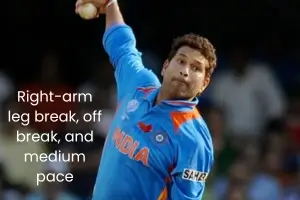
| Bowling Style | Right-arm Legbreak |
| Batting Career Summary | ||||
|---|---|---|---|---|
| Test | ODI | T20 | IPL | |
| Matches | 200 | 463 | 1 | 78 |
| Innings | 329 | 452 | 1 | 78 |
| Runs | 15921 | 18426 | 10 | 2334 |
| Balls | 29437 | 21367 | 12 | 1948 |
| Highest | 248 | 200 | 10 | 100 |
| Average | 53.79 | 44.83 | 10 | 33.83 |
| SR | 54.09 | 86.24 | 83.34 | 119.82 |
| Not Out | 33 | 41 | 0 | 9 |
| Fours | 2058 | 2016 | 2 | 295 |
| Sixes | 69 | 195 | 0 | 29 |
| Ducks | 14 | 20 | 0 | 4 |
| 50s | 68 | 96 | 0 | 13 |
| 100s | 51 | 49 | 0 | 1 |
| 200s | 6 | 1 | 0 | 0 |
| 300s | 0 | 0 | 0 | 0 |
| Bowling Career Summary | ||||
|---|---|---|---|---|
| Test | ODI | T20 | IPL | |
| Matches | 200 | 463 | 1 | 78 |
| Innings | 145 | 270 | 1 | 4 |
| Runs | 2492 | 6850 | 12 | 58 |
| Balls | 4240 | 8054 | 15 | 36 |
| Maidens | 83 | 24 | 0 | 0 |
| Wickets | 46 | 154 | 1 | 0 |
| Avg | 54.17 | 44.48 | 12 | 0 |
| Eco | 3.53 | 5.1 | 4.8 | 9.67 |
| SR | 92.17 | 52.3 | 15 | 0 |
| BBI | 3/10 | 5/32 | 1/12 | 0/7 |
| BBM | 3/14 | 5/32 | 1/12 | 0/7 |
| 4w | 0 | 4 | 0 | 0 |
| 5w | 0 | 2 | 0 | 0 |
| ICC RANKINGS | ||||||
|---|---|---|---|---|---|---|
| Current Rank | Best Rank | |||||
| Format | Batting | Bowling | All-Rounder | Batting | Bowling | All-Rounder |
| Test | -- | -- | -- | 1 | 56 | 8 |
| ODI | -- | -- | -- | 1 | 41 | 2 |
| T20I | -- | -- | -- | 63 | 56 | -- |
Master class Summary:
The glory chant Sachiiiiiin Sachin!
Throughout the extensive history of global cricket, few figures inspires as much passion, admiration, reverence of Sachin Ramesh Tendulkar. For more than twenty years, his existence on the cricket field represented more than just sporting excellence–it was a celebration of hope for millions. The Iconic chant of “Sachin! Sachin!” echoing through the crowded stadiums shared pride, trust, and national solidarity. These glorious cheers were not just sounds; they were sincere acknowledgements to a man who carried the aspirations of a nation upon his shoulders.
Sachin Tendulkar’s journey commenced at a very young age, and from his debut on the international appearance, it was evident that Indian cricket had discovered a remarkable talent. His skill, composure, and commitment distinguished him from others. As records shattered one after another–most runs in international cricket, centuries across various formats, and numerous match-defining innings–the chants intensified. Each four, every cover drive, and every milestones were met with resounding applause and rhythmic chants that turned stadium into shrines of cricket.
The Glory chant for Sachin Ramesh Tendulkar represents more than just admiration for his cricketing skills; it symbolizes hope and inspiration for a nation during tough times. His performances not only bought joy but also taught valuable lessons in discipline and humility. As a global icon of Indian cricket, Sachin earned respect from fans and opponents alike, with his legacy resonating worldwide.
Even after his retirement, he continues to inspire young cricketers, and the Bharat Ratna awarded to him signifies his immense contribution to the sport. Ultimately, the chant “Sachin! Sachin!” is an enduring celebration of his excellence and passion, forever etched in the hearts of fans.
The pinnacle of everything cricket
In a sport filled with statics, he holds nearly every significant batting record, including the most runs in Test and ODI cricket, the most hundreds in both formats, and the highest number of centuries in international cricket – an astonishing 100. Tendulkar discovered his true role at the top of the batting order when he was sent to open against New Zealand in 1994, scoring 82 off 49 balls. Despite a challenging beginning to his ODI career, he made the opening positing his own. By the time his career ended, he had amassed a total of 49 ODI hundreds outdoing the second-best by nineteen hundreds.
The Remarkable Cricketing Achievements
Sachin Tendulkar making his debut for India at the age sixteen, who holds multiple batting records, including the most runs and centuries in Test and ODI formats. After a challenging start, he excelled as an opener against New Zealand in 1994 and struck a 49-ball 82. Ultimately amassing 49 ODI hundreds, far surpassing his closest competitor.
Sachin Ramesh Tendulkar is celebrated as the highest run-scorer in International Cricket, amassing over 34,000 runs across Test matches and One Day with holding the record for 100 international centuries. His longevity in the sport is notable, as he played 200 Test matches over 24 year while maintaining high performance, showcasing his adaptability and technical skill.
A World Cup Experience
He participated in six World Cup tournaments from 1992 to 2011, finally in his triumph at 2nd April 2011 World Cup in front of his home crowd Mumbai. He made two final appearances, in 2003 and 2011, and was celebrated for his contributions to the Indian Cricket team, despite some failure regarding his performance under pressure. In the 2003 World Cup, he scored a remarkable 673 runs, setting a record that still stands, and in 2011, he was India’s highest run-scorer with 482 runs, helping lead the team to Victory. Virat Kohli expressed the nation’s gratitude, emphasizing the burden Tendulkar carried for over two decades. Ultimately, Tendulkar’s most cherished memory was receiving the long-awaited World Cup medal and trophy.
The Origination
Sachin Tendulkar’s journey into cricket began at age eleven when his half-brother, Ajit introduced him to coach Ramakant Acharekar at Sharadashram School in Mumbai. From that point, Tendulkar dedicated his life to cricket, changing schools and training extensively while quickly gaining fame in Mumbai for his impressive performance.
He achieved remarkable milestones, including a record-breaking partnership of 664 runs with Vinod Kambli and made his domestic debut at just 14 years old. Despite his youth, he impressed India’s captain Dilip Vengsakar and soon received national recognition, leading to his call-up to the Indian team.
The Youngster on a battleground
At just 16 years old, Sachin Tendulkar made his international cricket debut during India’s tour of Pakistan in 1989. Despite being dismissed for 15 runs in his first innings, he displayed remarkable courage when he was hit in the face by a bouncer from Waqar Younis. Instead of seeking medical help, Tendulkar continued to bat and scored an impressive 57 runs, helping India secure a draw in the final Test. This display of resilience and determination demonstrated his readiness for the challenges of international cricket, leading to his retention in the Test Squad.
Mastery of Heaven
After touring Pakistan, Sachin Tendulkar visited New Zealand, where he scored 88 runs in a Test match, narrowly missing the record for the youngest Test centurion. He achieved this milestone in 1990 during India’s tour of England, scoring 119* in a pivotal fourth innings at Manchester. Following this, he displayed exceptional form in Australia, scoring 148 in Sydney and becoming the youngest batsman to hit a Test hundred there, along with a notable 114 at the WACA.
His remarkable performances continued in South Africa, where he scored 169 runs in a challenging situation, earning admiration from even the formidable Allan Donald. Tendulkar also achieved his first Test century at home in Chennai with a score of 165 against England. In 1998, he faced Shane Warne in a much-anticipated contest, successfully employing a unique training method to score 155 in Chennai, leading India to a series victory against Australia.
The Captaincy
Tendulkar became the captain of the Indian Cricket Team in 1996 at 23, but faced challenges like a poor record and internal conflicts among senior players, yet he continued to perform well. After a disappointing second tenure that included a Test series loss to South Africa, he stepped down, and Sourav Ganguly took over in 2000 amid the match-fixing scandal.
The Master step up
1998 was remarkable year for Sachin Tendulkar, highlighted by his outstanding performances, including a memorable 143 in the Coca Cola Cup and a 134 in the final against Australia. He almost led India to victory against Pakistan in Chennai while batting back spasms, earning the Man of the Match despite the loss.
Tragically, Tendulkar lost his father during the 1999 World Cup, and returned home form England. He came back and scored 140 runs against Kenya to dedicate his father and establishing the ritual of looking up after scoring a hundred. In 2001, he played a crucial role in India’s victory over Australia in a deciding test match. However, 2002 saw a dip in his form, which he overcame with a remarkable 193 in Leeds, surpassing Sir Don Bradman’s century record.
Tendulkar excelled in the 2003 World Cup, scoring 673 runs and delivering an iconic innings against Pakistan. Though he continued to score heavily, including multiple double centuries, he faced a setback with a tennis elbow injury that sidelined him for much of 2004. He made a strong return at the end of that year, helping India secure a win against Australia.
Challenging Tendulkar
After a shoulder operation, Sachin Tendulkar made a successful return in the 2006 DLF Cup in Malaysia, scoring his 40th ODI century and reviving his career amidst challenges. Following a disappointing World Cup in 2007 and the ousting of coach Greg Chappell, Tendulkar’s recommendation of MS Dhoni as captain marked a turning point for Indian Cricket, leading to his resurgence in form.
He achieved several milestones, including becoming the highest run-scorer in Test cricket by surpassing Brain Lara’s record. Notably, in December 2008, he led India to victory against England in Chennai, providing hope after the Mumbai terrorist attacks. Tendulkar also excelled in the 2007-2008 Australia tour, scoring crucial runs and helping India secure its first ODI win on Australian soil.
In 2010, he became the first player to score a double century in ODI’s achieving 200* against South Africa. His remarkable form continued into the 2011 World Cup, where he contributed significantly to India’s triumph and celebrated the victory at the Wankhede Stadium, creating a historic moment in cricket.
The World Cup Aftermath
The aftermath of a stellar 2011 World Cup performance was a hangover. Tendulkar, still stuck on 99 international centuries, appeared to have a long wait ahead as he missed the milestone during two disastrous Test tours of England and Australia, where he came close but did not succeed. He finally reached the landmark after a year-long wait, scoring his 100th international hundred in an Asia Cup league against Bangladesh at Mirpur and helping India to 290, but India’s bowling failed at a crucial moment and conceded the match. His 51-run innings against Pakistan in the same tournament was his last ODI match, as he declared his ODI retirement.
Nation inspired with tears
Tendulkar, 24 years and a day after his test debut, said a tearful goodbye to Test cricket at Mumbai’s Wankhede Stadium on November 16, 2013. In his 200th Test match against the West Indies, Sachin made a significant contribution to India’s victory with a decent score of 74. When he was caught at slip and had to return to the pavilion, the Wankhede fell silent. His stirring post-match speech, in which he remarked that the “Sachin Sachin” chants would echo in his ears until his dying breath, inspired the crowd for another round of chanting–possibly the last one ever.